
It is mid-2026, and the summer leave calendar is filling up. A department head in Hong Kong is about to take her first proper break in two years, and she is quietly dreading it, not because the work is too complex for her team, but because she has never truly handed it over. Every approval, every client reply, every ‘quick question’ still routes through her. Her managers are capable; she hired them precisely because they are. Yet somehow, the operation runs smoothly only when she is in the room.
If that sounds familiar, you are not looking at a holiday-cover problem. You are looking at a delegation problem, and the summer slowdown makes it impossible to ignore. The leaders who have delegated well take a real break. The ones who haven’t spent their annual leave answering messages by the pool.
Most of the time, the problem is not effort. It is a belief. Almost every leader holds a few quiet assumptions about what delegation is, and those assumptions are usually what sabotage it. Three of them come up again and again, and almost all of them are wrong. Here is each one, and what to do instead. The encouraging news is that delegation is not a personality trait you either have or lack. It is a skill, and there is a well-tested model, Situational Leadership®, for getting it right.
Myth 1: Delegation Just Means Handing Over the Task
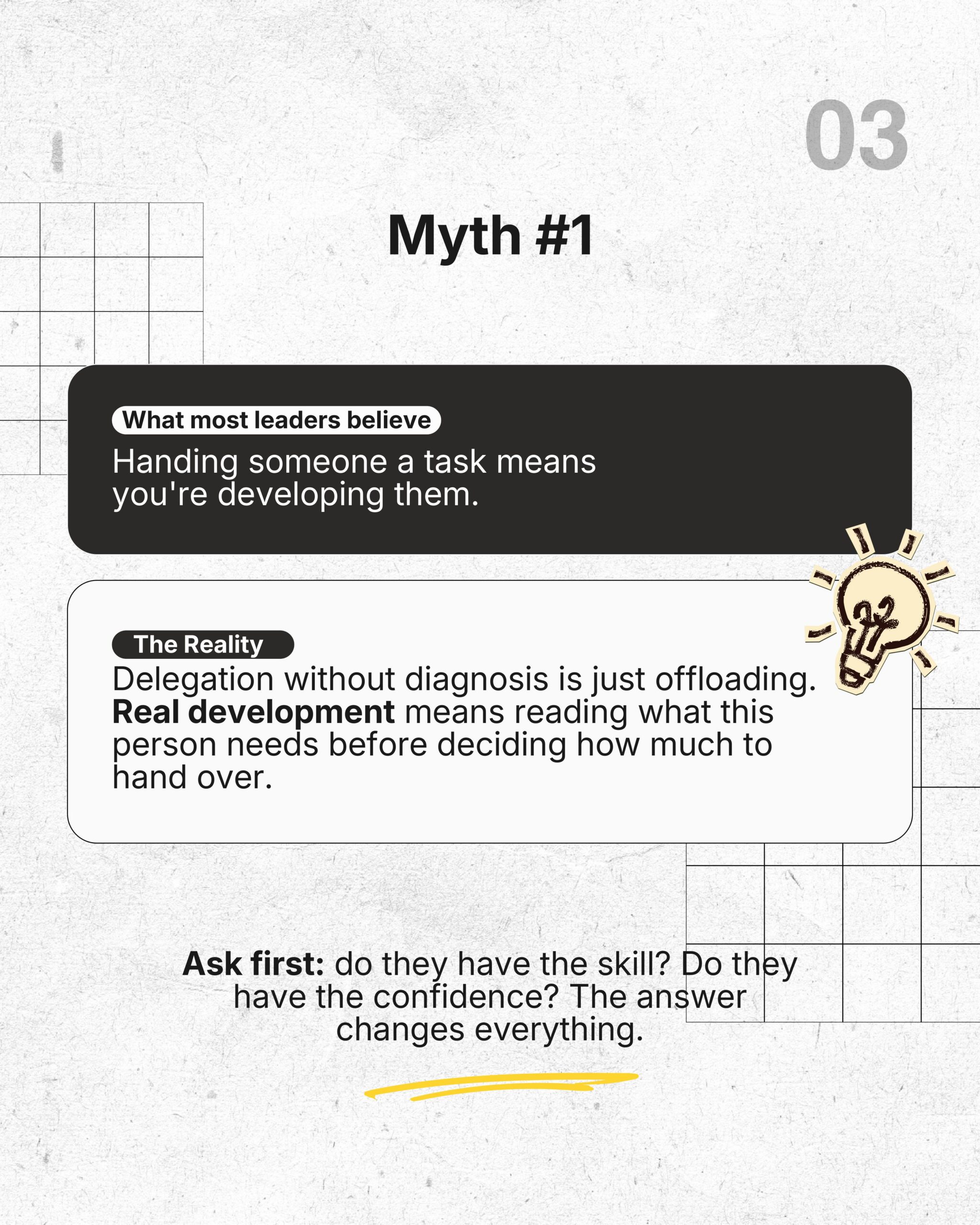
The most common belief is that delegation is an act of subtraction: give the task away, step back, and you are done. In reality, delegation without diagnosis is just offloading. Handing someone a task tells you nothing about whether they can do it well or grow from it. The work leaves your desk, but nobody is developed, and it often boomerangs back to you, late and half-finished.
The missing step takes about thirty seconds: reading what this person needs before you decide how much to hand over. Ask first, do they have the skill for this specific task, and do they have the confidence? The answer changes everything.
That diagnosis is the heart of Situational Leadership®, the model developed by Dr. Paul Hersey and refined over decades by the Center for Leadership Studies. It describes four ways to hand over a task, and delegation is the fourth, not the default:
- Telling: clear, specific direction and close supervision for someone new to the task and unsure about it.
- Selling: explaining the reasons and coaching someone who is motivated but still building skills.
- Participating: sharing the decision and building confidence for someone able but hesitant.
- Delegating: turning over both the decision and the execution to someone highly competent and fully committed.
You earn your way to that fourth style with each person, task by task. Use hands-off delegation on someone who is really at the Telling or Selling stage, and you are not delegating at all. You are offloading.
Myth 2: Handing Someone a Task Shows That You Trust Them
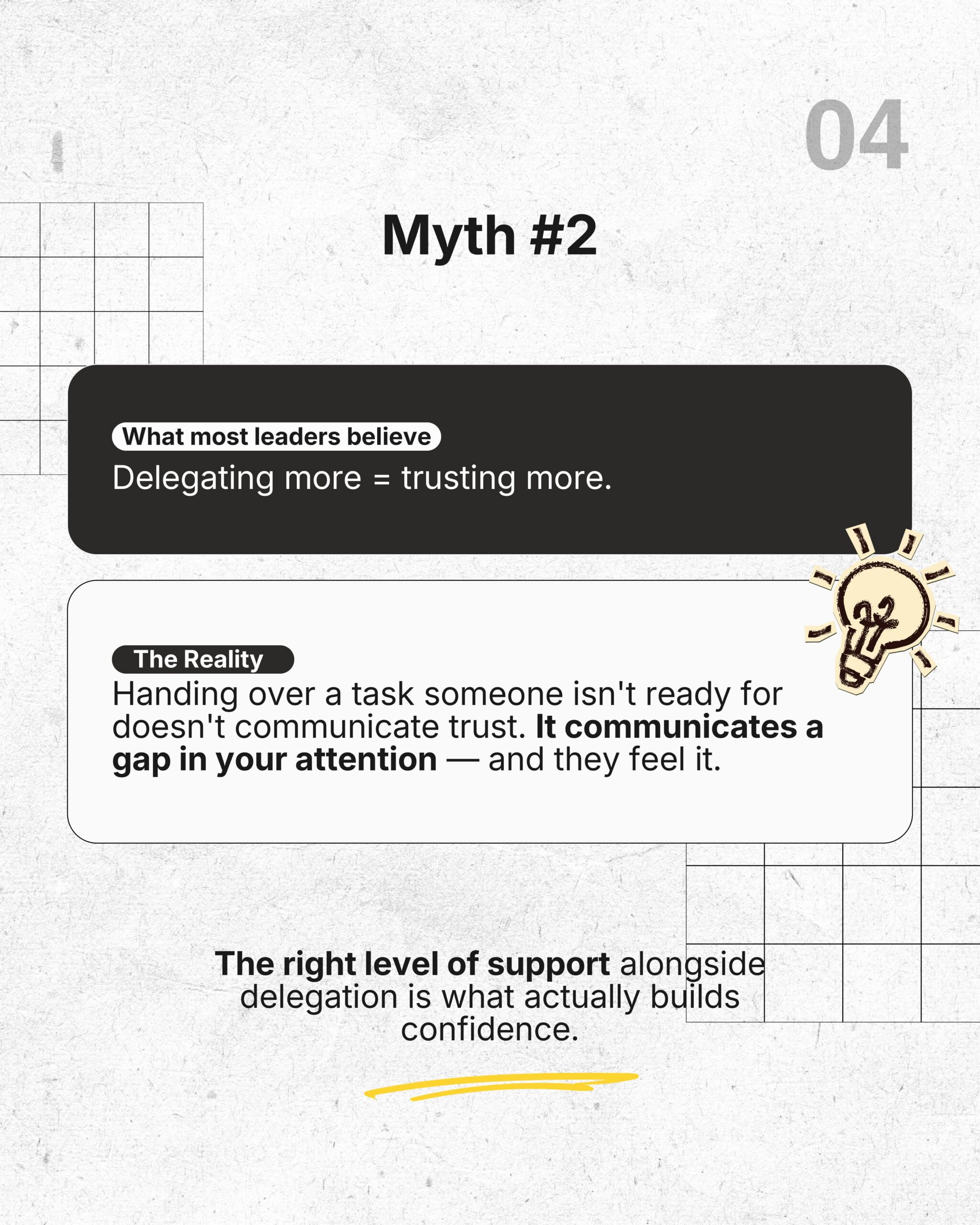
The second belief is that dropping a big task on someone signals confidence in them. When they are not ready, it does the opposite. Handing over a task someone cannot yet do well does not communicate trust. It communicates a gap in your attention, and they feel it. The right level of support attached to the task is what actually builds trust and confidence between the leader and the team.
In practice, that means matching your leadership style to your diagnosis rather than defaulting to a hands-off approach. New and unsure? Start with Telling. Skilled but hesitant? Participating will do far more than detailed instructions ever could. And do not skip stages: the most common cause of failed delegation is jumping straight to Delegating with someone who is really still at the Selling stage.
This is where two quiet mistakes cost you. One is a one-size-fits-all delegation approach, using the same hands-off style with everyone because it worked for your strongest performer. The other is mistaking silence for readiness, assuming that no questions means someone is fine when they may be quietly overwhelmed. Across the high-context workplaces of Hong Kong, Singapore, Malaysia, and the wider region, polite agreement can mask real uncertainty, which is why structured leadership training, practiced with real team scenarios, beats relying on instinct.
Myth 3: Once You Have Delegated, Your Job Is To Step Back
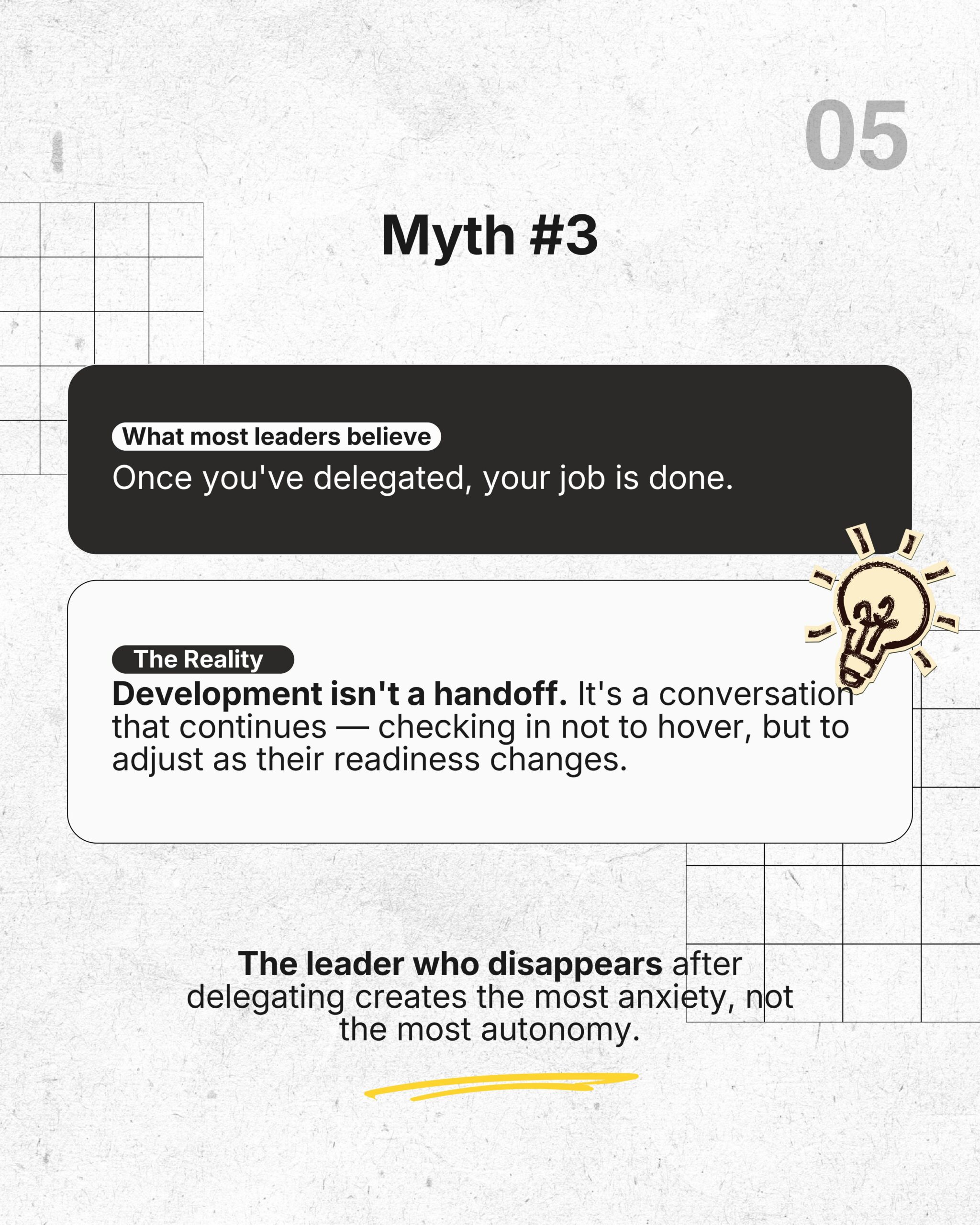
The third belief is that good delegation ends the moment the task changes hands. But development is not a handoff. It is a conversation that continues, checking in not to hover, but to adjust as the person’s readiness changes. The leader who disappears entirely after delegating creates the most anxiety, not the most autonomy.
Delegating well is not the same as vanishing. Agree on the check-in rhythm and decision rights up front, then hold to them. As readiness rises, deliberately pull your involvement back, so you need less of yourself over time. The opposite, reclaiming control at the first wobble, teaches people never to take ownership again. Staying lightly connected is what lets someone grow into the work instead of drowning in it.
The Thread That Ties The Three Together
Read side by side, the three myths share one root: treating delegation as a single act rather than a calibrated, ongoing relationship. Fixing that rarely comes from a single memo. It comes from genuine leadership and development, a Situational Leadership® workshop or program where managers learn the model, practice diagnosing readiness, and apply it to their own live situations, ideally with follow-up coaching so it sticks. Costs vary with the format, the number of managers involved, and the extent of tailoring your context needs, so it is best to scope an approach against your specific goals rather than a generic price.
If your managers are capable individually but the organization still depends on you being in the room, that gap is closable, and summer, with its quieter weeks and upcoming planning cycles, is a sensible time to start closing it. To explore how Situational Leadership® can help your team delegate in ways that genuinely develop people, visit CLS Asia or message the team on WhatsApp at +65 9134 8448.
📌 Want more actionable leadership insights?
👉 Follow CLS Asia on LinkedIn for regular updates, articles, and resources to help you lead with purpose and impact.