A few months ago, I sat in a leadership workshop with a senior manager who looked genuinely puzzled.
“I don’t get it,” he said. “I’ve always told my team they can be honest with me. Why don’t they speak up?”
It was a fair question.
By every measure, he was doing what good leaders are supposed to do. He held regular one-on-one meetings. He encouraged feedback. He checked in on his people and made time for conversations.
On paper, he was approachable. But when we spoke to his team, the story we heard was completely different.
One employee admitted she never brought up problems unless she absolutely had to. Another said he carefully rehearsed difficult conversations before speaking to his manager. A third simply smiled and said, “It’s easier to stay quiet.”
No one disliked their leader. In fact, they respected him. They just weren’t convinced it was safe to be completely honest. That conversation stayed with me because it captures one of the biggest challenges in leadership today.
Leadership isn’t measured by the story we tell ourselves. It’s measured by the experience people have when they work with us. And sometimes, those two stories are worlds apart.
The 95% Problem: A Self-Awareness Gap You Cannot Feel
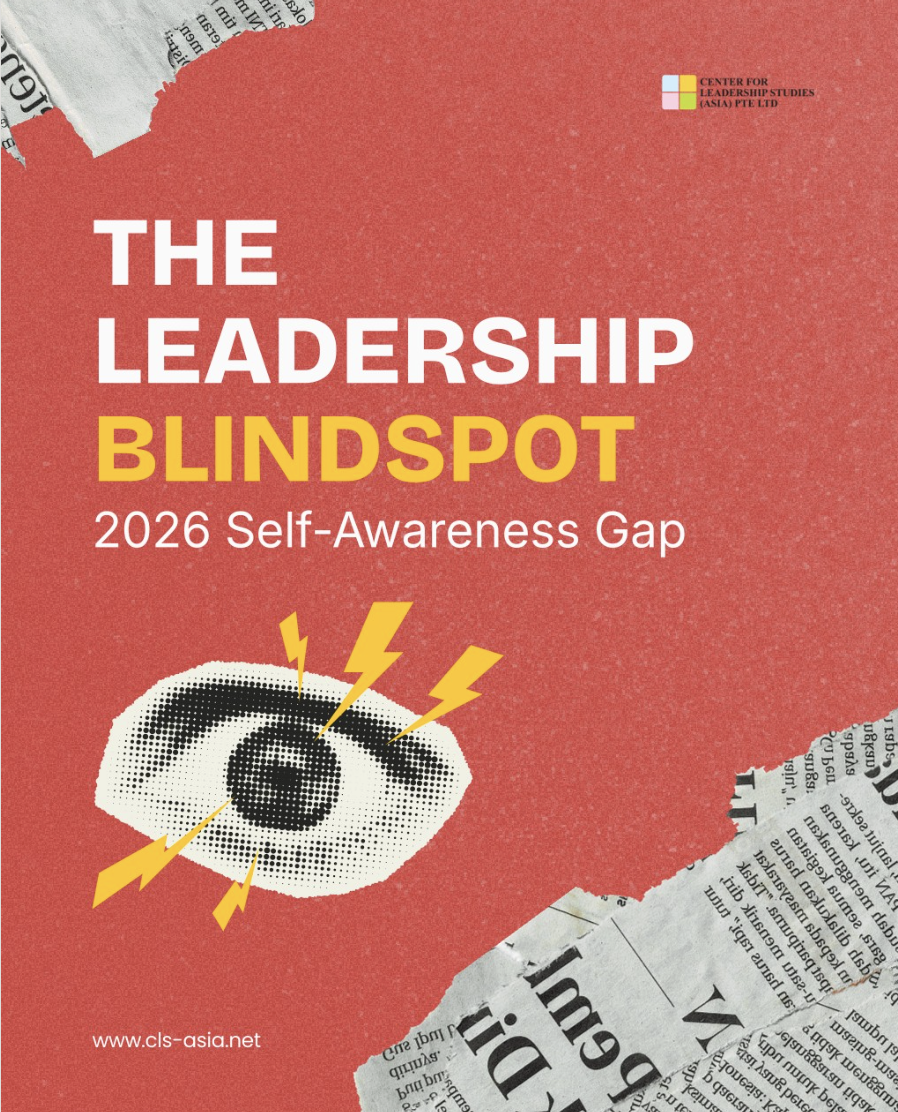
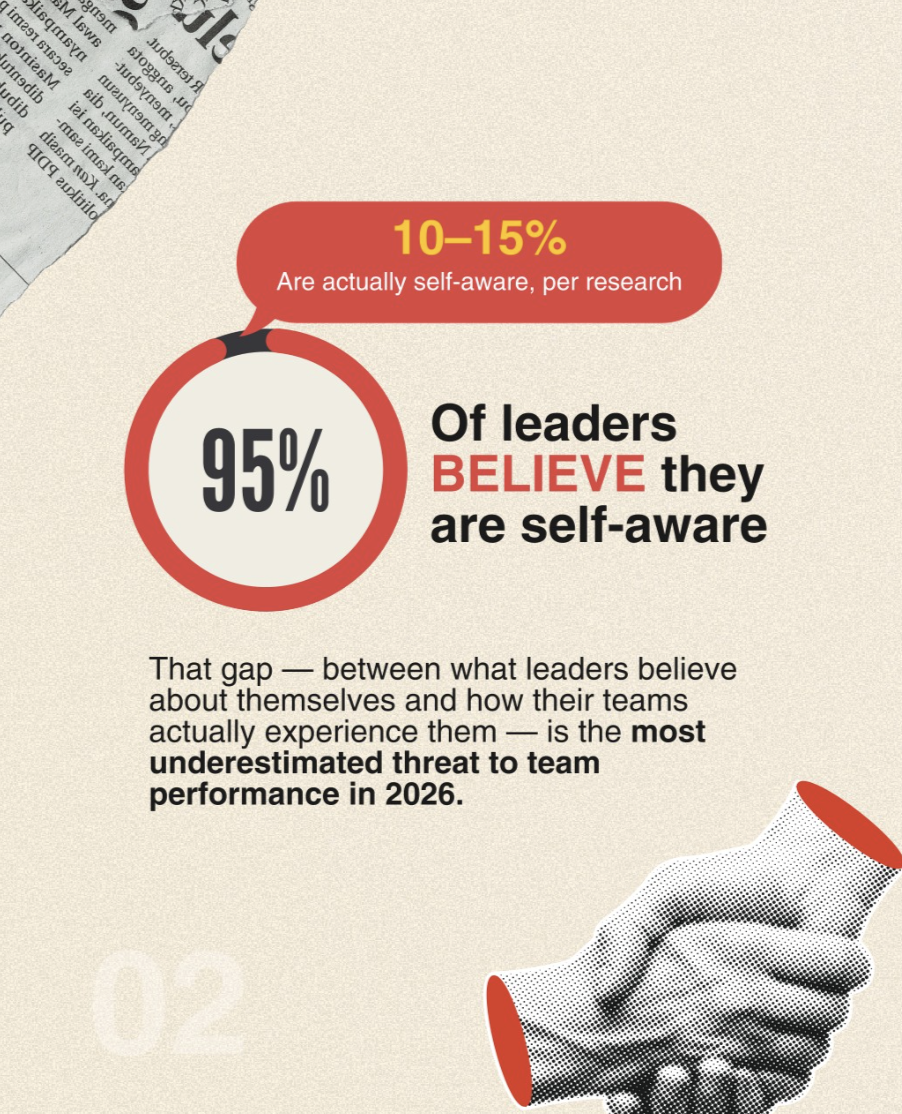
Here’s a statistic that should make every leader pause. Research popularized by organizational psychologist Dr. Tasha Eurich found that while around 95% of people believe they are self-aware, only 10 to 15% actually are.
Read that again.
Most of us believe we’re in the self-aware group. Statistically, most of us are wrong. The uncomfortable truth is that self-awareness is one of the few leadership capabilities that becomes harder to measure the more confident we are about having it. This isn’t because leaders are arrogant or dishonest. It’s because human beings naturally judge themselves by intention.
Everyone else judges us by impact.
A leader might think:
“I’m direct because I value efficiency.”
Their team may experience:
“I need to be careful what I say around them.”
Both perspectives can exist at the same time. Neither person is lying. They’re simply living two different realities. And because leaders only experience one of those realities their own it becomes incredibly difficult to spot the gap. The problem is that an invisible gap cannot be corrected.
And what we cannot see, we often pass on to everyone around us.
The Perception Gap Is the #1 Disengagement Driver
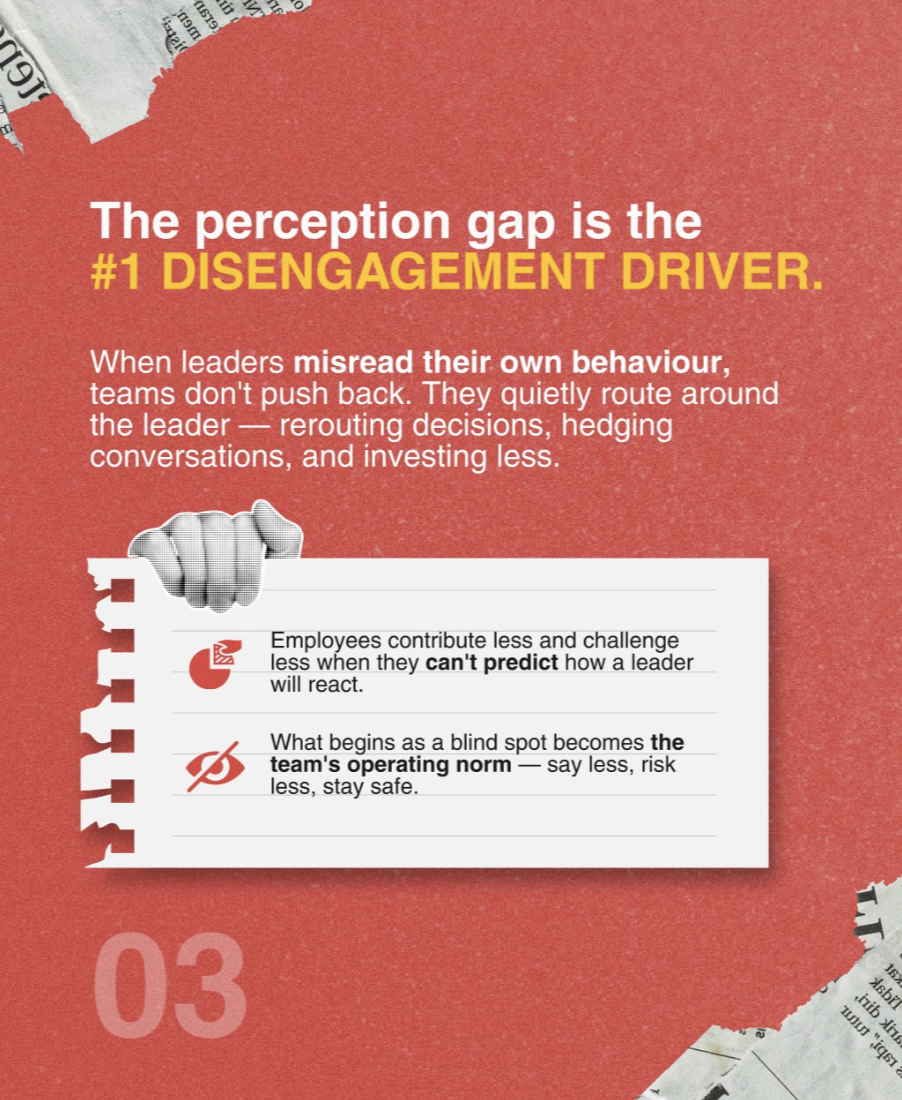
Disengagement rarely arrives with an announcement. It happens quietly.
A team member decides not to challenge an idea.
Someone chooses not to raise a concern.
A difficult conversation gets postponed.
An innovative idea stays inside someone’s head.
From the leader’s perspective, everything seems fine. Meetings are smooth, and there is little conflict. Nobody appears unhappy, but sometimes, that calm is the warning sign.
I once spoke with a regional leader who proudly told me:
“My team always agrees with me. We have great alignment.”
When we spoke to his employees, the story was different. They had simply learned that challenging ideas weren’t worth the effort. During previous meetings, he had unintentionally cut people off or dismissed suggestions too quickly. He wasn’t trying to silence anyone. He simply moved fast and valued efficiency. Over time, people adapted.
They stopped debating.
They stopped pushing back.
They stopped bringing bold ideas to the table.
The meetings became smoother.
The thinking became weaker.
And the leader interpreted the silence as agreement.
This is how the perception gap quietly becomes a performance problem.
Why This Happens Even More in Asia
Across much of Asia, respect for hierarchy runs deep. Many employees would rather preserve harmony than openly disagree with a senior leader. That means the feedback leaders need the most is often the feedback they are least likely to receive.
Silence starts looking like alignment.
Politeness looks like engagement.
A lack of complaints looks like trust.
Meanwhile, employees begin navigating around their leaders instead of through them. The result? Leaders continue making decisions based on a version of reality that no longer exists.
The Cruel Irony: The Leaders Who Need Awareness Most Seek It Least
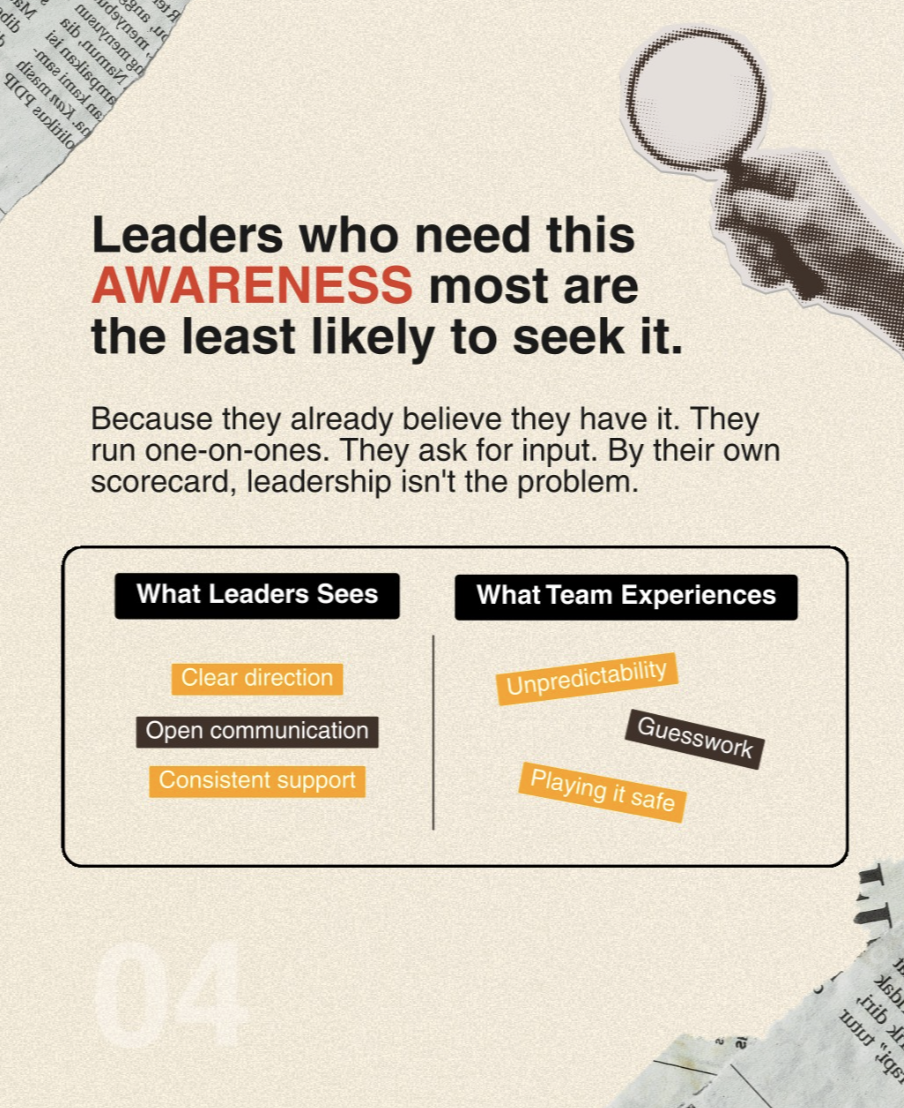
The leaders who need self-awareness the most are often the ones least likely to seek it. Because from their perspective, everything is already working.
They hold regular meetings.
They ask for opinions.
They maintain an open-door policy.
By their own scorecard, leadership isn’t the problem. But a scorecard you create for yourself isn’t a measurement.
It’s a mirror.
And mirrors don’t always tell the whole story. This is why emotional intelligence begins with self-awareness. Before leaders can manage relationships, inspire others, or navigate conflict, they need to understand the effect they have on people. Without self-awareness, leadership effectiveness becomes guesswork.
Good intentions alone are not enough.
You Can’t Flex a Style You Can’t See: The Hidden Cost of Misdiagnosis
Leadership experts often talk about adaptability.
The best leaders know how to be directive when people need clarity and supportive when people need encouragement. But adaptability depends on one thing:
Knowing what leadership style you’re actually using. That’s where many leaders struggle. Under pressure, people default to familiar behaviours. Some leaders take control. Some become collaborative. Others step back entirely.
None of these responses are wrong.
The problem begins when they become automatic. Imagine a new employee who desperately needs guidance and structure. Instead, their manager gives them complete autonomy, or imagine a high performer who is ready for independence but receives constant supervision.
Neither leader intended to make the wrong decision.
They simply misdiagnosed what the person needed, and misdiagnosis almost always begins with a lack of self-awareness. Because every leadership decision is filtered through our habits, assumptions, and preferred ways of working.
If we cannot see those patterns clearly, we struggle to adapt.
As the saying goes:
You can’t flex your style if you can’t see what style you’re actually using.
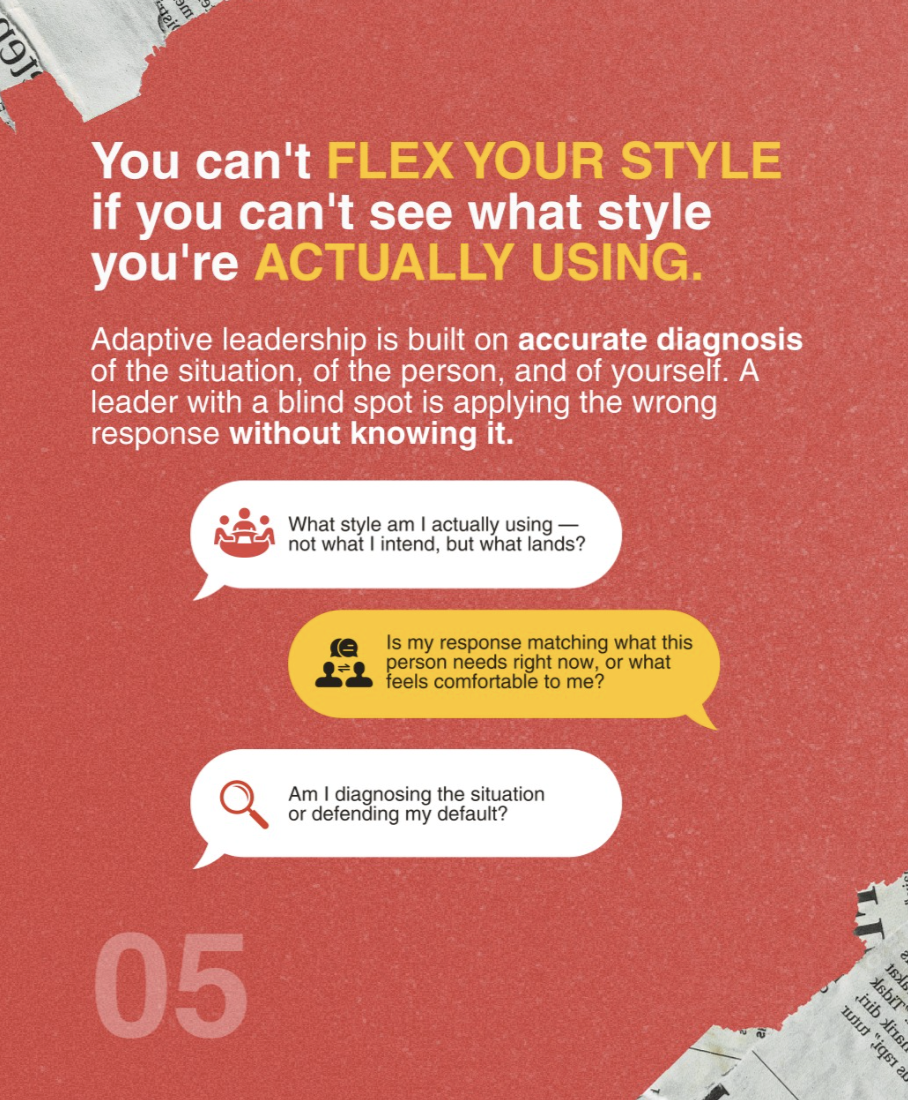
Three Questions Every Leader Should Ask
Before your next important conversation, pause and ask yourself:
- What leadership style am I demonstrating right now not the one I intend, but the one my team experiences?
- Am I responding to what this person genuinely needs, or simply to what feels comfortable for me?
- Am I diagnosing the situation objectively, or defending my default approach?
The leaders who ask these questions consistently become more intentional, more adaptable, and ultimately more effective. Because exceptional leadership is rarely about having more tools. It’s about knowing when to use them.
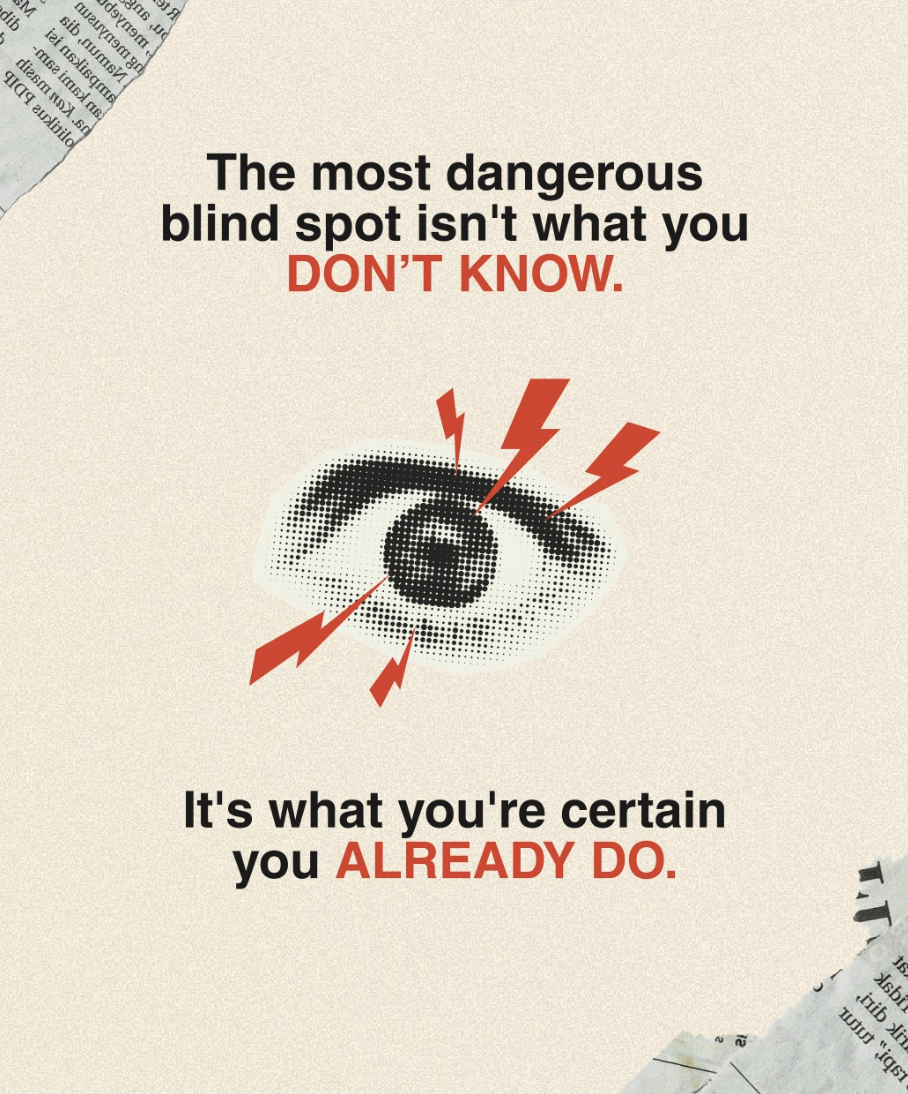
The Most Dangerous Blind Spot Is the One You’re Certain About
The behaviours we question are usually the behaviours we improve. The behaviours we are absolutely certain about? Those are the ones we stop examining.
“I’m approachable.”
“I always listen.”
“I empower my people.”
These assumptions often go unchallenged for years and that’s where blind spots quietly grow. The good news is that self-awareness is not a personality trait reserved for a lucky few.
It is a discipline.
It can be developed.
It can be measured.
It can be coached.
The leaders who close the gap tend to do three things consistently:
- They actively seek honest feedback.
- They use tools that compare intention with impact.
- They treat unexpected reactions from their teams as valuable data rather than personal criticism.
This week, try one simple exercise. Think about the person on your team you find the most challenging. Then ask yourself:
“What might I be contributing to this dynamic that I can’t currently see?”
The discomfort that follows may be the beginning of genuine growth, because real leadership development isn’t about collecting more frameworks. It’s about having the humility to question the story you’ve been telling yourself.
The most effective leaders aren’t the ones without blind spots. They’re the ones who assume they have them and keep looking.
Close the Gap Before It Closes Your Team
An invisible blind spot doesn’t announce itself. It just quietly caps what your team is willing to give, one unspoken concern, one hedged conversation, one ‘never mind’ at a time.
You don’t have to lead by guesswork. Give your leaders a proven, repeatable framework to see their own style clearly and flex it with intentions, the foundation of genuine leadership effectiveness and lasting leadership development.
Ready to close the self-awareness gap? Visit CLS Asia or speak with our team on WhatsApp at +65 9134 8448 to bring Situational Leadership® to your leaders.
Want more actionable leadership insights like this? Follow CLS Asia on LinkedIn.